By Muhammad Mansoor Haidar, owner and developer · Last updated October 25, 2026
17 correct out of 20 questions
85% · B
Each question is worth 5% on a 20-question quiz.
| Grade | Needs at least | Most questions you can miss | Score at that limit |
|---|---|---|---|
| A | 90% | 2 | 90% |
| B | 80% | 4 | 80% |
| C | 70% | 6 | 70% |
| D | 60% | 8 | 60% |
Half credit counts as half a missed question: enter 0.5 for one half-credit miss. Your teacher’s scale and rounding rule decide the official grade.
How a quiz grade is worked out
Count the correct answers, divide by the number of questions, and multiply by 100. On a 20-question quiz with 3 wrong, that is 17 ÷ 20 × 100 = 85%. The letter then comes from your scale: 85% is a B on the standard scale and a B on the plus/minus scale too.
The same division gives the value of one question: 100 ÷ number of questions. On a 20-question quiz each question is worth 5 points; on a 10-question quiz each is worth 10. That single number explains why short quizzes feel so unforgiving.
How many can I miss for each grade?
The allowance table under the calculator answers this for every boundary at once. The rule behind it is simple: the most questions you can miss for a grade is the largest whole number of misses that still keeps the score at or above that grade’s cutoff.
On a 20-question quiz the allowances are: A, at most 2 wrong; B, at most 4; C, at most 6; D, at most 8. Change the quiz size above and the whole table recomputes.
Why small quizzes swing grades
A quiz grade is a coarse measurement: with only 10 questions there are just 11 possible scores, and each miss moves the result a full letter step in places. Two students who both understand most of the material can land a full grade apart on one unlucky question.
Teachers handle this by weighting quizzes lightly, dropping the lowest quiz, or averaging several quizzes before the score counts. If your syllabus drops a lowest score, average the rest first and grade that average — grading each quiz separately and then dropping one gives the same result only when every quiz has the same number of questions.
Partial credit on quizzes
A half-credit answer is half a miss: enter 0.5 in the missed field for each question that earned half marks. Two half-credit answers equal one full miss, and the percent follows the same division as always.
If your teacher awards partial credit per question rather than per quiz, add the partial points together first. Three questions at half credit each are 1.5 missed, not 3 — entering 3 would understate the score by a full question’s value.
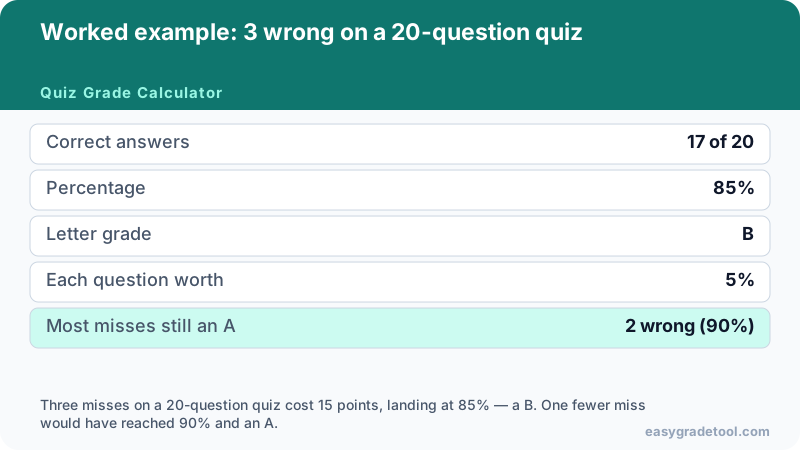
Worked example: 3 wrong on a 20-question quiz
A 20-question quiz with 3 wrong answers, graded on the standard scale.
- Correct answers
- 17 of 20
- Percentage
- 85%
- Letter grade
- B
- Each question worth
- 5%
- Most misses still an A
- 2 wrong (90%)
Three misses on a 20-question quiz cost 15 points, landing at 85% — a B. One fewer miss would have reached 90% and an A.
Charts and examples: Quiz Grade Calculator
Quiz grade questions
How quiz scores are computed, what each miss costs, and how partial credit works.
Interactive Tools Available
Grade a quiz
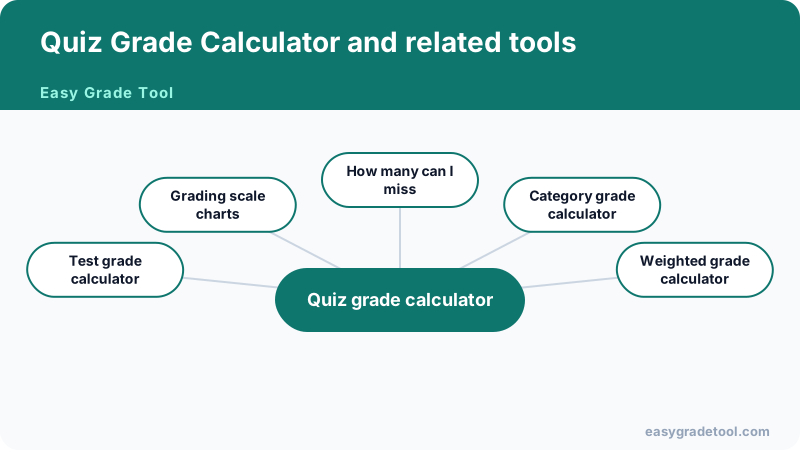
Related grade calculators
- Test grade calculatorPoints-based grading for tests of any size.
- Grading scale chartsScore charts for tests of 5 to 100 questions.
- How many can I missMiss allowances for every test size.
- Category grade calculatorTurn quiz, homework and test scores into a course grade.
- Weighted grade calculatorCourse grades from weighted assessments.