By Muhammad Mansoor Haidar, owner and developer · Last updated October 25, 2026
Bonus points or late penalty (optional)
42 of 50 points after adjustments · 8 points missed before bonus.
| Grade | Minimum | Points needed | You are |
|---|---|---|---|
| A | 90% | 45 | 3 short |
| B | 80% | 40 | at or above |
| C | 70% | 35 | at or above |
| D | 60% | 30 | at or above |
Points to percent: the one formula
Percent = points earned ÷ points possible × 100. That is the entire conversion, and it works for any total: 137 out of 160 is 137 ÷ 160 × 100 = 85.6%, and 88 out of 100 is 88.0%. The letter grade then follows from the scale your class uses.
The formula also runs backwards. To find the points needed for a target percent, multiply the target by the points possible: 90% of 160 is 144 points. Anything at or above that total earns at least an A on the standard scale.
Points needed for the next grade
A points total makes the next grade concrete in a way a percent does not. "You need 7 more points" is a plan; "you need 4.4% more" is not. The table under the calculator lists the points needed for every grade boundary on the total you entered, rounded up to whole points where the total is whole.
On a 160-point total, an A starts at 144 points. A student at 137 points is 7 points short — one strong answer, or a few partial-credit points, depending on how the work is marked.
Why points beat percentages for grading
Percentages hide size. A 90% on a 10-point quiz and a 90% on a 200-point exam look identical, but the exam result rests on twenty times as much evidence. Points keep that size visible, which is why gradebooks store points and only display percents.
Points also make combining work honest. Adding two percents and averaging them treats a quiz and an exam as equals, which they are not. Adding their points — total earned over total possible — weights each piece by its size automatically.
Points versus percent in gradebooks
If your gradebook shows a percent but asks for points, enter the points: the percent is computed from them, and rounding the percent first can shift the letter at a boundary. A stored 89.6% and a stored 90% are different grades, but both round to "about 90" in conversation.
When a gradebook shows only a letter, work backwards through the scale’s cutoff. A B on the standard scale means the percent was somewhere from 80% to 89.99%; the exact points are unrecoverable from the letter alone, so keep the points whenever you can.
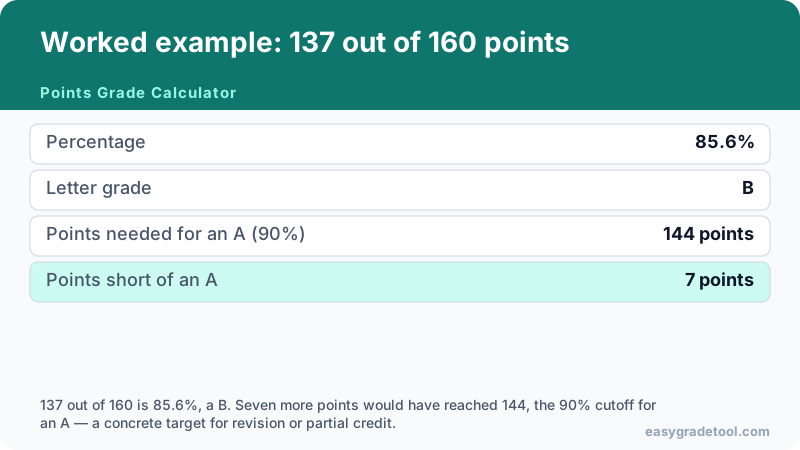
Worked example: 137 out of 160 points
A project worth 160 points, graded on the standard scale.
- Percentage
- 85.6%
- Letter grade
- B
- Points needed for an A (90%)
- 144 points
- Points short of an A
- 7 points
137 out of 160 is 85.6%, a B. Seven more points would have reached 144, the 90% cutoff for an A — a concrete target for revision or partial credit.
Charts and examples: Points Grade Calculator
Points grade questions
Converting points to percent and letter, points needed per grade, and combining assignments.
Interactive Tools Available
Convert points to a grade
Related grade calculators
- Test grade calculatorPercentage and letter for one test, with bonus points.
- Quiz grade calculatorQuestion-count grading for quizzes.
- Assignment grade calculatorLate penalties and extra credit included.
- Letter grade calculatorPercent, letter and GPA points on common scales.
- Average grade calculatorMean and median for a list of scores.